
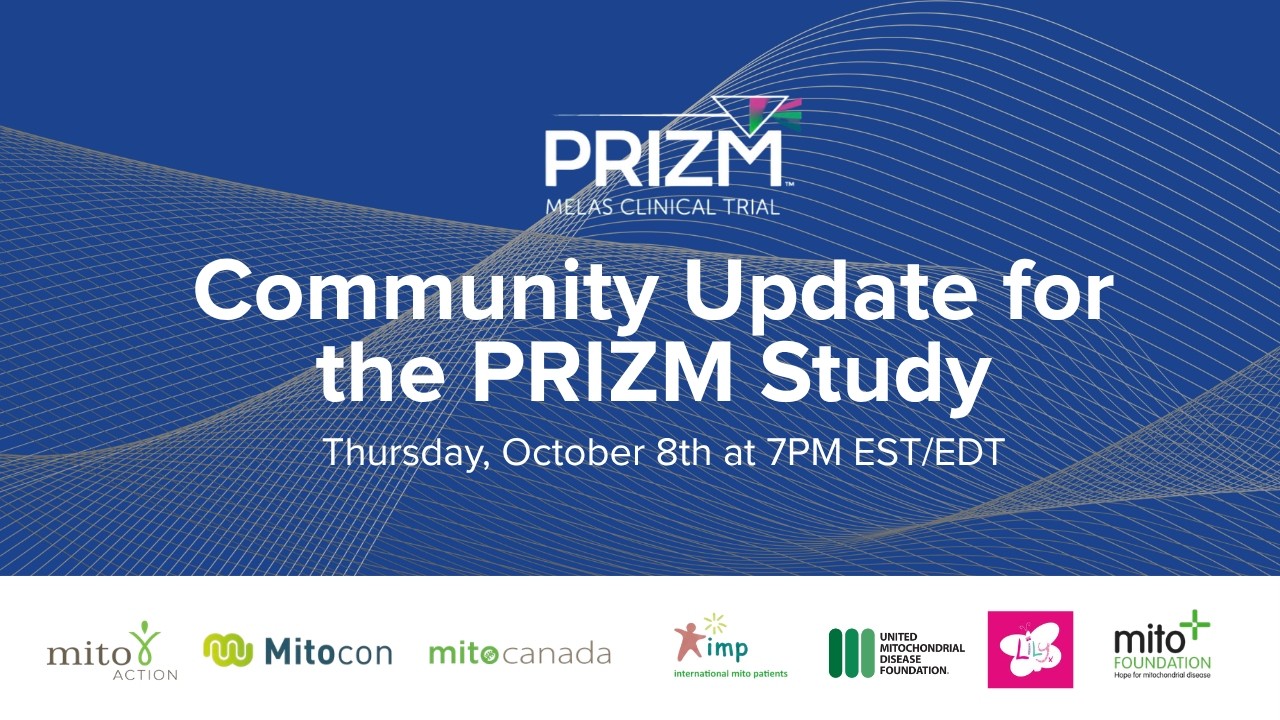
This Community Update from Tisento Therapeutics was held Thursday, October 8, 2026, at 7 p.m. EST, with MitoAction, UMDF, International Mito Patients, The Lily Foundation, Mito Canada, Mito Foundation, and Mitocon.
A Message from Tisento Therapeutics
Originally published on https://www.tisentotx.com/community-letters/update-october-0726
Dear MELAS Community,
We are writing to share our decision to discontinue the development of zagociguat as a treatment for MELAS and other primary mitochondrialRelated to the mitochondria. diseases. We made this decision because zagociguat did not show a treatment benefit in the Phase 2b PRIZM study. As a result, we are ending the ongoing open-label extension study, and study teams have contacted participants about next steps.
We know that this news is deeply disappointing to the MELAS and broader mitochondrial disease community, and we share that disappointment. We are profoundly grateful to study participants and their families for the time and commitment they devoted to the study. We also thank the investigators, study coordinators, and advocacy organizations that supported the study and its participants.
While PRIZM did not produce the benefits for MELAS patients that we had hoped to see, every individual and family who participated helped advance our understanding of the disease and contributed to the broader effort to improve future care and treatment options for people living with MELAS.
Study participants and investigators have been informed of the results through study-site communications, and we are committed to sharing findings with the broader MELAS community in a timely and transparent manner. As a next step, a community webinar will be held tomorrow, October 8ᵗʰ. Patients, families, and advocates can find webinar details below.
We have been humbled and inspired by this community and remain hopeful for the future of research in MELAS and other mitochondrial diseases.
With gratitude,
The Zagociguat team and all of us at Tisento Therapeutics
PRIZM Study Results Summary
The PRIZM study assessed symptoms that people living with MELAS identified as important, including fatigueThe overall feeling of tiredness or lack of energy. It is not the same as simply feeling drowsy or sleepy. Being fatigued means having no motivation or energy., cognitive function limitations, exercise intolerance, and muscle weakness. The selection of these endpoints was informed by an interview study that gathered the experiences of adults with MELAS to ensure that PRIZM measured the most relevant and meaningful aspects of the disease.
We carefully analyzed all key efficacy and safety data before making the decision to discontinue our development of zagociguat. Although PRIZM did not achieve the outcome we hoped for, the results did provide a clear answer to the question the study was designed to assess. The study did not meet any of its primary or secondary endpoints, and no benefits were observed for zagociguat over placeboAn inactive substance or treatment that looks the same as, and is given in the same way as, an active drug or intervention/treatment being studied., including within predefined subgroups. The safety profile of zagociguat was consistent with prior studies, and no safety signals were identified.
About the Speaker

Chad Glasser, PharmD, MPH, is Vice President of Clinical Research at Tisento Therapeutics. Chad has more than 14 years of clinical research experience, having worked on a range of preclinical to late-stage programs spanning infectious disease, oncology, and multiple rare disease therapeutic areas. For the last seven years, he has focused on advancing the zagociguat clinical program, first at Cyclerion then through the transition to Tisento. Prior to Cyclerion, Chad was a clinical scientist at Acceleron Pharma (acquired by Merck), and before that, he completed a two-year post-doctoral clinical research fellowship and started his career at Cubist Pharmaceuticals (acquired by Merck).